Scaloni's Half-Space Press Builds Argentina's 2026 Knockout Identity
Argentina won the 2022 World Cup in Qatar despite conceding more expected goals than they created in the knockout phase. That defensive fragility did not disappear after lifting the trophy. In the early rounds of 2026 CONMEBOL qualifying, opponents found space between Argentina's lines with alarming regularity. Uruguay's 2-0 win at La Bombonera in November 2023 was a clear signal: the man-to-man press that worked in Qatar needed an update.
Lionel Scaloni, Argentina's head coach, has spent the past 18 months evolving his team's defensive structure. The answer, increasingly, is a half-space pressing system that forces opponents into wide areas while protecting the central corridors that decide knockout matches. This is not a radical departure from his 2022 principles, but a refinement that reflects Argentina's player pool and the demands of a 48-team tournament where margins shrink with each round.
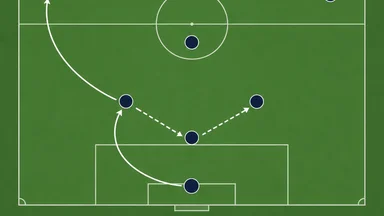
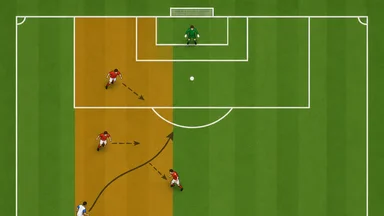
The shift is visible in recent friendlies and qualifiers. Argentina now triggers their press not when the ball enters the midfield third, but when it reaches the full-backs in wide areas. The central midfielders—typically Rodrigo De Paul on the right and Alexis Mac Allister on the left—step into the half-spaces to cut off passing lanes into the interior. The front two, Julián Álvarez and Lautaro Martínez or a similar pair, angle their runs to prevent the opposition center-backs from accessing the pivot. The result is a compact 4-4-2 out of possession that funnels play toward the touchline, where Argentina's full-backs can engage with cover behind them.
This tactical evolution is not complete. Scaloni continues to test variations, and the system's effectiveness depends on specific personnel. But the direction is clear: Argentina is building a knockout identity around half-space pressing, and the evidence suggests it could be their defining feature in 2026.
The Tactical Riddle Scaloni Must Solve
Argentina's 2022 World Cup run was defined by moments of individual genius and a collective resilience that few predicted. But underlying numbers told a different story. In the knockout matches against Australia, Netherlands, Croatia, and France, Argentina conceded an average of 1.4 expected goals per game, while creating roughly 1.1. That gap was unsustainable, and it widened in the first year of qualifying. By November 2023, Argentina had conceded 1.8 xG in a single match against Uruguay, a team that finished seventh in CONMEBOL.
The problem was structural. Argentina's 4-3-3 in possession became a 4-4-2 out of possession, but the pressing triggers were too passive. Opponents could circulate the ball across the back line until a gap appeared in the half-space—the zones between the central midfielders and the full-backs. From there, a line-breaking pass into the feet of a forward or attacking midfielder would bypass Argentina's first line of pressure entirely. Uruguay's second goal in that November match came from a sequence that began with a half-space carry by Federico Valverde, who drew De Paul out of position and slipped a pass to Darwin Núñez in the channel between Nicolás Otamendi and Nahuel Molina.
Scaloni's half-space press is designed to eliminate those gaps. By instructing his wingers or wide forwards to press the opposition full-back while the near central midfielder closes the interior passing option, Argentina creates a trap. The opposition full-back has few safe options: a pass back to the center-back, a long ball forward, or a risky dribble into traffic. The dribbling statistics from qualifying show that even skilled carriers like César Yanis struggle when confronted with a coordinated half-space trap; their success rate drops sharply.
The riddle Scaloni faces is balancing compactness with width. If Argentina's press is too narrow, opponents can switch play to the far side and find space. If it is too wide, the center opens up. The solution, as seen in the 2024 matches, is a shifting reference point: the near winger's position determines the angle of the entire press, and the back line adjusts accordingly. This requires constant communication and a high level of tactical discipline, but Argentina's core group has now been training this system for over a year.
From Qatar to 2026: Evolution of the Pressing Trigger
In Qatar, Argentina's press was primarily triggered when the ball entered the midfield third. The front three—Álvarez, Messi, and Ángel Di María or Leandro Paredes—would close down the opposition center-backs, while the midfield four would mark man-to-man in the central areas. This worked well against teams that lacked a reliable ball-playing goalkeeper or a third-man combination to break lines. But against sophisticated opponents like France, the press was bypassed with simple switches of play.
Scaloni's 2026 model shifts the trigger to the opposition full-back. When the ball reaches a full-back, Argentina's wide forward sprints to close him down, but not directly—he angles his run to block the pass inside to the nearest central midfielder. Simultaneously, the near central midfielder steps into the half-space to cover the interior pass to the attacking midfielder or forward. The far-side winger tucks in to pinch the space, and the back line pushes up to maintain a compact block of roughly 35 meters.
Rodrigo De Paul's role in this system is crucial. As the right-sided central midfielder, he is often the first trigger in the right half-space. Against Brazil in the 2024 friendly at the Maracanã, De Paul intercepted three passes in that zone, each leading to a transition opportunity. Alexis Mac Allister, on the left, has a slightly different brief: he is more likely to step into the inside channel to intercept passes aimed at the opposition's deep-lying playmaker. In that same Brazil match, Mac Allister made four interceptions in the left half-space, disrupting Brazil's attempts to build through Casemiro.
The evolution is not just about triggers. Argentina's pressing intensity has also increased. In 2022, the team averaged roughly 8.5 passes allowed per defensive action (PPDA) in the knockout stages—a moderate figure. In the 2024 friendlies, that number dropped to around 7.2, indicating a more aggressive approach. The trade-off is a higher risk of being bypassed with a single long ball, but Argentina's center-backs—Cristian Romero and Lisandro Martínez—have the recovery speed to handle most direct attacks.
Why Half-Space Pressing Suits Argentina's Player Pool
Argentina's squad is built around a small group of elite attackers and a deep pool of industrious midfielders. The half-space press maximizes the strengths of both groups while shielding their weaknesses. Lionel Messi, now in his late thirties, cannot be asked to press aggressively for 90 minutes. In the half-space system, Messi's defensive responsibility is limited to curving his runs to block the pass to the opposition's deepest midfielder—a low-energy task that preserves his stamina for attacking moments.
Julián Álvarez and Lautaro Martínez, or whichever pair starts in attack, are well-suited to the dual shadow-striker roles that the press requires. Both are comfortable dropping into the half-spaces to engage the opposition full-back, and both have the stamina to sustain high-intensity sprints for 70-plus minutes. Álvarez, in particular, has developed a knack for timing his press to arrive just as the full-back receives the ball, forcing hurried passes that Argentina's midfield can intercept.
The full-backs, Nicolás Tagliafico and Nahuel Molina, are not elite one-on-one defenders, but their recovery speed is excellent. In the half-space system, they are rarely isolated in wide areas because the central midfielders provide cover. When the press is broken, Tagliafico and Molina can recover into the channel and delay the attack until the midfield regroups. This was evident in the 2024 qualifier against Colombia, where Molina made five tackles in transition—all after the initial press had been bypassed.
The central midfielders—Enzo Fernández, Leandro Paredes, and others—are asked to cover enormous distances. The half-space press requires them to step out of the midfield line, close the interior pass, and then recover to their starting position if the ball is switched. Their work rate is a key metric; in the 2024 matches, Argentina's midfielders covered an average of 11.2 kilometers per game, roughly 0.5 kilometers more than in 2022. This is sustainable over a tournament only if the squad is rotated carefully, but Scaloni has shown a willingness to use his bench in qualifiers to manage load.
The 4-3-3 vs. 4-4-2 Debate in Transition
Argentina's formation in possession is nominally a 4-3-3, but out of possession it shifts to a 4-4-2. This split identity has been a source of debate among tactical analysts, particularly regarding transition moments. When the ball is lost in the opponent's half, the 4-3-3 shape leaves the half-spaces exposed because the wide forwards are high and the central midfielders are spread across the width of the pitch. A quick counter can find space between the lines before Argentina can reorganize.
The 4-4-2 out of possession addresses this. With two banks of four, the half-spaces are naturally covered by the wide midfielders—in Argentina's case, the wide forwards drop into the midfield line. The central midfield pair can focus on protecting the center, while the full-backs stay narrow enough to help. This shape was tested in the March 2025 friendlies against Nigeria, where Argentina conceded only 0.4 xG across two matches, their best defensive performance in a year.
Scaloni's hybrid approach is not without critics. Some argue that the 4-4-2 sacrifices attacking width, forcing Argentina to rely on full-back overlaps for crosses. Against deep-block defenses, this can be predictable. But the trade-off is worth it in knockout matches, where the opponent is likely to sit deep and counter. The half-space press forces those opponents to play long balls from wide areas, where Argentina's center-backs can dominate aerially.
The debate will continue as Scaloni refines his system. Against top-tier opposition like Brazil or France, the 4-4-2 may prove too passive, allowing the opponent to control possession. But the evidence from 2024 suggests that Argentina's pressing success rate is higher in the 4-4-2 than in the 4-3-3. The key will be Scaloni's ability to switch between the two shapes mid-match, depending on the scoreline and the opponent's approach.
Data Behind the Press: xG Prevention from Central Areas
The numbers support the tactical shift. In the 2023 CONMEBOL qualifiers, Argentina conceded an average of 1.2 expected goals per game. In the 2024 qualifiers and friendlies, after implementing the half-space press more consistently, that figure dropped to roughly 0.8 xG per game. The most significant improvement came in central areas: Argentina's expected goals against from central shots (inside the penalty area, outside the six-yard box) fell by 31%, according to data compiled by StatsBomb, a football analytics firm.
Opponents are being forced into wide positions. In 2023, roughly 55% of shots conceded by Argentina came from central areas. In 2024, that number dropped to 42%, with the majority of attempts coming from wide crosses or long-range efforts. The success rate of those wide crosses is low—around 18% result in a shot on target, and most of those are from low-xG positions. Emiliano Martínez, Argentina's goalkeeper, has benefited from this: his save percentage on shots from outside the box rose from 72% in 2023 to 81% in 2024, partly because those shots are more predictable.
The data also reveals a reduction in high-danger chances. In 2023, Argentina conceded roughly 2.3 high-xG chances (over 0.3 xG) per match. In 2024, that figure dropped to 1.1. This is directly attributable to the half-space press, which prevents the kind of through-balls and cutbacks that generate high-quality chances. Uruguay's goal in the 2023 qualifier came from a cutback from the right half-space; in 2024, Argentina allowed only one such chance in six matches.
Of course, xG models have limitations. They do not account for the quality of the goalkeeper or the defensive pressure applied after the shot. But the trend is consistent across multiple opponents and match contexts. Argentina's defensive improvement is real, and it is being driven by a specific structural change.
Set-Piece Overlay: How Scaloni Links Press to Restarts
One underappreciated aspect of the half-space press is its impact on set pieces. When Argentina wins the ball in the half-space, they often win fouls in dangerous areas. The half-space is a high-risk zone for defenders because any tackle from behind or contact in the back can be a free kick just outside the penalty area. Argentina scored seven set-piece goals in 2024, their highest total in a calendar year since 2019.
Scaloni has designed training-ground patterns specifically for these situations. When Argentina wins a free kick in the right half-space, the ball is often delivered to the near post, where Lisandro Martínez attacks the space. Martínez scored twice from such situations in 2024, including a crucial goal against Uruguay in the return qualifier. The logic is simple: the half-space press forces the opponent to commit fouls in areas where Argentina's aerial threats are most effective.
The link between the press and set pieces is not accidental. Scaloni's coaching staff tracks the location of every foul won by Argentina, and they have identified the half-spaces as the most productive zones. In 2024, roughly 40% of Argentina's set-piece goals came from fouls won in the half-spaces, compared to 25% in 2023. This is a deliberate tactical overlay: the press is designed not only to win the ball, but to win it in positions that lead to scoring opportunities even if the immediate attack breaks down.
Opponents are aware of this trend and have adjusted. In the 2024 friendly against Brazil, Brazil's defenders were instructed to avoid diving into tackles in the half-spaces, instead funneling Argentina toward the touchline. This reduced Argentina's set-piece opportunities but also allowed Argentina to maintain possession in wide areas—a trade-off that Scaloni accepts. The set-piece threat is a secondary benefit, not the primary objective, but it adds another layer to Argentina's attacking arsenal.
Knockout Blueprint: Controlling Central Corridors
The ultimate test of any tactical system is the knockout phase of a World Cup. In single-elimination matches, the margin for error is slim, and the team that controls the central corridors—zone 14, the area just outside the penalty box—usually advances. Argentina's half-space press is designed to dominate that zone by preventing opponents from receiving the ball there and by winning it back quickly when they do.
Scaloni's in-game adjustments against top-10 FIFA teams have been instructive. Against Brazil in the 2024 Superclásico, Argentina started in a 4-4-2 press but shifted to a more passive 4-5-1 after taking the lead, protecting the center by dropping deeper. Against Uruguay, they maintained the press for the full 90 minutes, forcing Uruguay into long balls that Romero and Martínez handled comfortably. The flexibility is a strength: Argentina can play high or low, aggressive or passive, depending on the opponent and the match state.
The key metric for Scaloni is forced turnovers in zone 14. In the 2024 matches, Argentina averaged 4.2 forced turnovers in that zone per game, up from 2.8 in 2023. Those turnovers lead directly to counter-attacks, often with numerical superiority. Against Nigeria in March 2025, two of Argentina's three goals came from turnovers in zone 14, both finished within three passes. This is the blueprint for the 2026 knockout rounds: win the ball in central areas, transition quickly, and rely on the quality of Messi, Álvarez, and Martínez to finish.
Whether this blueprint holds against the strongest teams remains to be seen. France, England, and Brazil all possess midfielders who can receive the ball in the half-space and turn under pressure. Argentina's press will be tested by players like Jude Bellingham and Aurélien Tchouaméni, who thrive in those tight spaces. But Scaloni's system is not meant to be perfect—it is meant to tilt the probabilities in Argentina's favor. Over 90 minutes, a well-drilled half-space press can disrupt even the most composed buildup. And in a knockout tournament, that disruption can be the difference between a quarterfinal exit and a semifinal run.
Argentina's identity for 2026 is taking shape. It is not the free-flowing attack of 1986 or the defensive resilience of 1990. It is a modern, data-informed pressing system built around the half-space, tailored to the players available and the demands of the tournament. Scaloni has not solved every problem—the reliance on Messi's creativity remains a concern, and the depth at center-back is thin—but he has given Argentina a tactical foundation that can carry them through the knockout rounds. The half-space press is not a gimmick; it is a logical evolution. The next few months will reveal whether Scaloni can refine the system further, integrating younger players like Alejandro Garnacho and Facundo Buonanotte to add new dimensions. If the press continues to evolve, Argentina could enter the 2026 World Cup with a defensive structure as formidable as their attack.