Saudi Arabia’s 2026 Attack Counts on Uncapped Winger Musab Al-Juwayr
When Saudi Arabia stunned Argentina at the 2022 World Cup, the left wing belonged to Salem Al-Dawsari, whose curling winner remains the defining image of that campaign. Two years on, the Green Falcons' attack has lost some of its edge. Al-Dawsari is now 31, carrying a heavier injury load, and the supporting cast on the flanks has thinned. Enter Musab Al-Juwayr, a 21-year-old Al-Hilal winger who has yet to earn a senior international cap but leads the Saudi Pro League's under-23 cohort in dribbles and expected assists. His emergence could give coach Herve Renard a fresh weapon as the 2026 World Cup cycle intensifies.
The Uncapped Winger Who Could Reshape Saudi Arabia's Attack
Al-Juwayr is not a household name outside Riyadh. He has made only a handful of senior appearances for Al-Hilal, the domestic powerhouse, and spent part of the 2023 season on loan at Al-Fayha to gain minutes. His senior national team debut remains elusive, but the statistical case is building. This season in the Saudi Pro League, he averages 4.3 completed dribbles per 90 minutes, a figure that places him among the top five wide players in the division. For context, Al-Dawsari averaged 2.8 dribbles per 90 during his World Cup–qualifying campaign.
His style is direct, right-footed, and most dangerous when drifting in from the left flank. He can cut inside to shoot—his five league goals this season came from a combined xG of 3.1, indicating good finishing quality—or drive to the byline to pull crosses back. His 0.28 expected assists per 90 ranks first among Saudi wingers under 23 and suggests a creative ceiling that the national team currently lacks.
Comparisons to Al-Dawsari are inevitable, but they are more structural than stylistic. Both players operate from the left in a 4-3-3, both have a willingness to take defenders one-on-one, and both have emerged from Al-Hilal's youth system. Al-Juwayr is less of a playmaker than Al-Dawsari—his key passes per 90 sit at 2.1, slightly below the veteran's 2.5—but his dribbling volume creates space that the team's midfielders can exploit.
Why Saudi Arabia's Wing Play Has Stalled Since Qatar 2022
The drop-off in wide production is measurable. In the current AFC qualifying round for the 2026 World Cup, Saudi Arabia averages 1.8 successful dribbles per game across all attacking players, down from 2.4 in the 2022 cycle. Cross accuracy has slipped from 32 percent to 27 percent. Al-Dawsari remains the primary creative outlet, but his minutes have been managed due to recurring hamstring issues—he missed three qualifiers in 2024 alone.
Fahad Al-Muwallad, once the team's most explosive wide option, has not regained his pre-doping-ban form. Since returning in early 2024, he has registered just one goal and two assists in league play. Al-Buraikan has shifted centrally, reducing the depth on the flanks. Marwan Al-Sahafi, another wide candidate, has struggled for consistency at the club level, with only 0.9 key passes per 90 this season.
The result is a reliance on fullback crosses—Saudi Arabia attempted 18 crosses per match in the 2026 qualifiers, the highest rate in Group C—but with limited success. Fullbacks like Saud Abdulhamid and Ali Al-Bulaihi are solid defensively but do not offer the same danger as a specialist winger. Al-Juwayr's ability to beat his man and draw fouls (3.1 fouls drawn per 90) could relieve pressure on the fullbacks to create.
Al-Juwayr's Statistical Profile: Dribbles, Chances, and xG
Breaking down the numbers further: Al-Juwayr's 4.3 dribbles per 90 come with a 62 percent success rate, well above the league average for wingers (48 percent). He attempts 7.1 dribbles per 90, indicating high confidence and a mandate from his coaches to take risks. His progressive carries—dribbles that move the ball toward the opponent's goal by at least five yards—total 5.2 per 90, again top among U23 wide players.
His chance creation is less about volume and more about quality. The 0.28 expected assists per 90 is built on passes that frequently lead to shots from high-danger areas—inside the penalty box rather than from distance. Assists themselves are only two in the league this season, but that figure is depressed by Al-Hilal's finishing variance; his passes have generated 4.1 xA in total, meaning teammates have underperformed relative to the chances created.
Defensively, Al-Juwayr contributes 1.2 tackles per 90 and 0.8 interceptions. Those numbers are modest but meet the baseline Renard expects from wide players in his 4-3-3. The French coach has historically demanded that wingers track back and help the fullbacks, especially in transition. Al-Juwayr's work rate is acceptable, though not exceptional, which may be the area where he needs to improve most to earn a starting role.
Tactical Fit: How Herve Renard Could Deploy Al-Juwayr
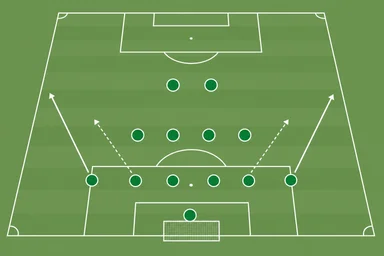
Renard's 4-3-3 is built on defensive solidity and quick transitions. The wide forwards are expected to stay high and wide in possession, then pinch in to support the central midfielder when the team defends. Al-Juwayr's right-footed left-wing profile is a natural fit: he can receive the ball on the touchline, drive inside onto his stronger foot, and either shoot or slip a pass to the striker or the onrushing left-back.
In the 2026 qualifiers, Saudi Arabia has often struggled to break down compact defenses—teams like Japan and Iran sit deep and force the Falcons to play through the middle. Al-Juwayr's dribbling could be a release valve, drawing two defenders and freeing space for others. His willingness to shoot from distance (1.8 shots per 90, 0.9 from outside the box) adds another dimension that Al-Dawsari has provided but that the current squad lacks from other wide options.
Renard has also shown a willingness to use young players. In his first stint with Saudi Arabia, he gave caps to players like Firas Al-Buraikan and Abdulelah Al-Malki early in their careers. For the 2026 cycle, he has already integrated several U23 players into the squad. Al-Juwayr's lack of senior caps is a hurdle, but Renard's track record suggests it is not an insurmountable one if the player performs in training and in club matches.
Competition for Minutes: Al-Dawsari, Al-Buraikan, and Others
Al-Dawsari remains the undisputed first-choice left winger when fit. His experience, leadership, and ability to produce in big moments—his 2022 World Cup goal is proof—will keep him in the starting XI for the remainder of the qualifying campaign. But Renard has already begun managing his minutes. In the October 2024 qualifiers, Al-Dawsari played the full 90 against Japan but was substituted after 65 minutes against Australia. The need for a reliable deputy is clear.
Al-Buraikan has moved to a central striker role, where he has scored four goals in qualifying. That shift opens up the left-wing spot when Al-Dawsari rests. Al-Muwallad, once the natural replacement, has not convinced. His dribbling numbers have dropped to 1.6 per 90, and his decision-making in the final third has been erratic. Al-Sahafi, who plays on the right for Al-Ittihad, has been tried on the left but produces only 0.8 key passes per 90 in that role.
Al-Juwayr's loan spell at Al-Fayha in 2023 was pivotal. In 18 appearances, he logged 1,200 minutes—more than he had in two previous seasons at Al-Hilal combined. He scored three goals and added two assists, but the real gain was match sharpness and the confidence to take on defenders in a competitive environment. Upon returning to Al-Hilal, he earned more minutes off the bench and has started four league matches this season.
The Risk of Throwing a Rookie into World Cup Qualifying
Al-Juwayr has never played in a competitive senior international match. His only exposure to the national team setup came in a few friendly camps, where he did not feature in any official games. The jump from club football to AFC qualifying, especially away from home against teams like Japan and Iran, is substantial. The intensity, the pressure of playing in front of 50,000 fans at King Fahd Stadium, and the tactical discipline required are all unknowns.
Renard has experience with such gambles. In 2015, he handed a debut to Omar Abdulrahman, then a relatively untested 22-year-old, in a crucial Asian Cup qualifier. Abdulrahman went on to become a key player, but he also had a period of inconsistency. The risk is that Al-Juwayr's inexperience could be exposed against organized defenses that double-team him, or that the physicality of international football could lead to early injuries.
There is also the question of psychological readiness. Al-Juwayr has not faced the kind of hostile atmospheres that await in Seoul, Tehran, or Melbourne. His performance in high-stakes club matches—such as the Saudi Pro League title decider or the Asian Champions League—has been limited. Al-Hilal's depth means he rarely plays the full 90 in tight games. Renard will have to assess whether Al-Juwayr can handle the pressure without the safety net of a senior teammate beside him.
What Al-Juwayr Must Prove Before the 2026 Squad Is Named
The timeline is tight. The 2026 World Cup kicks off in June 2026, meaning the squad will likely be finalized by early 2026. Al-Juwayr has roughly 18 months to establish himself as a reliable option. The first requirement is consistency over a full club season. He has shown flashes but has not sustained a high level for more than a few matches at a time. A run of 10 consecutive starts with consistent dribbling and chance creation would go a long way.
Second is link-up play with the aging midfield core. Salman Al-Faraj, now 35, and Mohamed Kanno, 30, are the likely starters in central midfield. Al-Juwayr will need to develop an understanding with them—timing his runs, checking into pockets, and combining in tight spaces. In training camps, he must demonstrate that he can read their movements and provide a reliable outlet.
Third is performance away from home. Saudi Arabia's toughest qualifiers are on the road. Al-Juwayr's club form has been solid at Al-Hilal's home stadium but less impressive in away matches—his dribble success rate drops to 54 percent away from home. He needs to show he can replicate his production in hostile environments.
Finally, a senior call-up for the 2025 Gulf Cup, scheduled for early 2025, would serve as a natural trial run. That tournament typically features less intense pressure than World Cup qualifying and could allow Al-Juwayr to earn his first caps without the weight of expectation. If he performs there, the case for his inclusion in the 2026 squad becomes much stronger.
None of this guarantees success. Wingers with elite dribbling stats often fail to translate that production to the international stage, where space is compressed and defenders are more disciplined. But Saudi Arabia cannot afford to ignore a player who leads his age group in key attacking metrics. The 2026 World Cup is still two years away, and the Green Falcons' attack needs a new dimension. Musab Al-Juwayr may not be the finished product, but he is the most promising uncapped option available.
Alternative Approaches: What If Al-Juwayr Doesn't Work Out?
Should Al-Juwayr fail to adapt, Renard has other options, though each comes with trade-offs. One possibility is shifting to a 4-2-3-1 formation that uses a number 10 behind the striker, reducing reliance on wide dribblers. This would allow Al-Dawsari to play centrally, where his creativity could be maximized, but it would also expose the fullbacks to more defensive duties. Another option is promoting a younger winger from the U23 squad, such as Abdulaziz Al-Faraj (no relation to Salman), who has impressed in the Saudi First Division with 2.1 dribbles per 90. However, Al-Faraj lacks top-flight experience and would face the same inexperience issues as Al-Juwayr.
Renard could also lean more heavily on fullback overlaps, using Saud Abdulhamid as an auxiliary winger. Abdulhamid has shown attacking ambition, with 1.2 key passes per 90 and 2.3 crosses per game. But this would leave defensive gaps, especially against counter-attacking teams like Japan. The trade-off between defensive solidity and attacking threat is a constant challenge for Renard, and Al-Juwayr's emergence offers a chance to strike a better balance.
Ultimately, the decision may come down to Al-Juwayr's performance in the 2025 Gulf Cup. If he shines, he could force his way into the starting XI. If he struggles, Renard will need to look elsewhere. Either way, the 2026 World Cup will be a test of Saudi Arabia's ability to develop and integrate young talent.